The Sun is enormous. The first step is asking better questions.
About SolDaily.com
SolDaily.com is a manga-powered solar science and solar energy education site. It uses characters like The Solar Man, Solar Sensei, Professor Photon, Madame Corona, Captain Flare, Earth Girl Terra, PV Boy, and the Solar Wind Riders to explain the Sun and the practical story of solar power.
SolDaily.com is not a breaking-news service. It is an educational and editorial project built like a manga special about the Sun. The name suggests a daily relationship with Sol: sunlight, science, energy, Earth systems, and practical solar literacy.
The Solar Man is the main hero of SolDaily.com. He became one with the Sun as a symbolic messenger of solar understanding. He gives the site its mythic center and connects the Sun to life, power, weather, farming, technology, and human meaning.
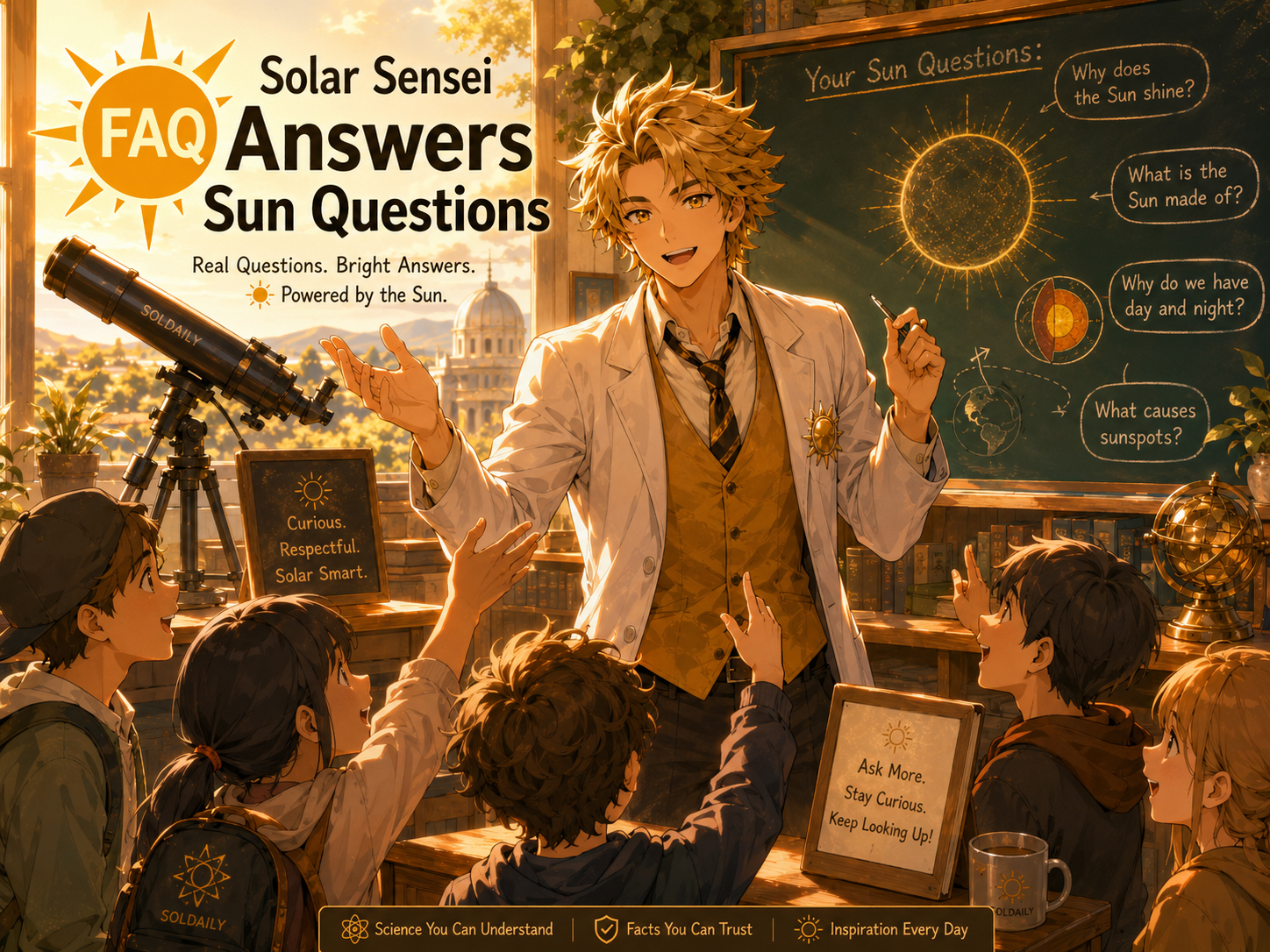
Solar Sensei is the calm teacher of SolDaily.com. He turns solar drama into clear lessons, defines terms, corrects myths, and keeps the science grounded.
Professor Photon is the tiny blazing genius who explains photons, sunlight, radiation, wavelength, and the journey of light from the Sun to Earth and into solar panels.
Sun science questions
The Sun is a star: a massive sphere of hot plasma held together by gravity. It shines because nuclear fusion in its core releases energy. For the full beginner lesson, start with What Is the Sun?.
No. The Sun does not shine because of ordinary fire or combustion. It shines because nuclear fusion in the core converts hydrogen into helium and releases energy. See Nuclear Fusion.
Photons are packets of electromagnetic energy. Sunlight can be understood as photons traveling from the Sun to Earth. Professor Photon explains the journey on Photons and Sunlight.
Solar radiation is energy from the Sun traveling through space. It includes visible light, infrared, ultraviolet, and other electromagnetic energy. Read Solar Radiation.
Sunspots are dark-looking regions on the Sun’s visible surface. They look dark because they are cooler than the surrounding solar surface, but they are still extremely hot and magnetically important. Read Sunspots.
No. A solar flare is a burst of radiation from sudden magnetic energy release. A coronal mass ejection, or CME, is a large eruption of plasma and magnetic field into space. They can occur together, but they are different events. See Solar Flares and Coronal Mass Ejections.
Earth, climate, and life questions
The Sun provides light and energy that support photosynthesis, warmth, weather, the water cycle, seasons, food chains, and daily rhythms. Read The Sun and Life on Earth.
No. Seasons are mainly caused by Earth’s axial tilt, which changes sunlight angle and daylight length through the year. Read Seasons and Earth Tilt.
Solar energy helps water evaporate from oceans, lakes, soil, and plants. That water vapor forms clouds and returns as rain or snow, helping support rivers, groundwater, farming, and ecosystems. Read The Sun and Water Cycle.
Solar power questions
Photovoltaic solar panels convert part of incoming sunlight into electricity. Photons transfer energy to electrons in solar cells, producing DC electricity that an inverter can convert into AC power. Read How Solar Panels Use Sunlight.
No. Photovoltaic panels use light. Heat can affect performance, and excessive panel temperature can reduce output. A clear cool day can be excellent for solar production.
Solar panels produce DC electricity. Most buildings use AC electricity. An inverter converts solar DC electricity into AC electricity and may also provide monitoring, grid interaction, safety functions, and battery coordination. Read Inverters and Solar Power.
Batteries store electrical energy for later use. They can support backup loads, evening use, time-of-use strategies, or resilience goals depending on design. Batteries do not make energy; they move energy in time. Read Batteries and Solar Energy.
Not necessarily. Many grid-tied solar systems shut down during utility outages for safety unless they are designed with approved backup, battery, or islanding capability. Backup behavior depends on equipment, configuration, protected loads, utility rules, and inspection.
Space weather and eclipse questions
Space weather means changing conditions in space, often driven by solar activity, that can affect satellites, GPS, radio, aviation, power systems, and auroras. Read Space Weather and Space Weather Warning.
No. Most people on the ground are protected by Earth’s atmosphere and magnetic field. Space weather matters most through technology systems and official operations. Use official sources for real-time alerts and qualified guidance.
No. Ordinary sunglasses are not safe for direct solar viewing. Use proper eclipse glasses or handheld solar viewers that meet appropriate safety standards, or use indirect projection methods. Read Safe Solar Eclipse Viewing.
Safety and disclaimer questions
No. SolDaily.com is educational only and is not medical advice, diagnosis, treatment, eye-care guidance, skin-care guidance, heat-illness guidance, or emergency medical advice. Read Solar Science Is Not Medical Advice.
No. SolDaily.com explains concepts but does not provide engineering advice, stamped design, permit drawings, electrical design, structural calculations, battery layout approval, code interpretation, or utility interconnection approval. Read Not Engineering Advice.
No. SolDaily.com is not telescope training, solar-filter instruction, astrophotography instruction, navigation advice, eclipse-event operations planning, or professional observing guidance. Read Not Astronomy Instruction.
ABC Solar questions
SolDaily.com is a solar science and solar education project associated with ABC Solar Incorporated. The site uses manga storytelling to explain solar concepts, while ABC Solar brings real-world field experience with solar projects, roofs, batteries, inverters, utility coordination, permits, and monitoring.
Contact ABC Solar Incorporated at 1-310-373-3169 or [email protected]. You can also use the Contact page.
What Is the Sun?
Begin the SolDaily science path with the star that powers the whole story.
Start Sun scienceSolar Lessons from ABC Solar
Connect the manga science to roof reality, batteries, inverters, utility rules, permits, and real solar projects.
Read field lessons